This website uses cookies to give you the best user experience. If you continue
without changing your settings we'll assume you are happy to receive all RSC cookies.
You can change your cookie settings by navigating to our Privacy and Cookies page and following the instructions. These instructions
are also obtainable from the privacy link at the bottom of any RSC page.
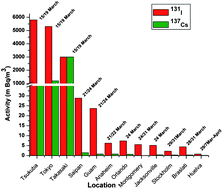
The release of radioactivity into the atmosphere from the damaged Fukushima Daiichi nuclear power plant started on March 12th, 2011. Among the various radionuclides released, iodine -131 (131I) and cesium isotopes (137Cs and 134Cs) were transported across the Pacific Ocean and reached the United States on 17–18 March 2011. Consequently, an elevated level of fission products 131I, 132I, 132Te, 134Cs and 137Cs were detected in air, water, and milk samples collected across the United States between March 17 and April 4, 2011. The continuous monitoring of activities over a period of 25 days and spatial variations across more than 100 sampling locations in the United States made it possible to characterize the contaminated air masses. For the entire period, the highest detected activity values ranged from less than 1 m Bq m−3 to 31 m Bq m−3 for the particulate 131I, and up to 96 m Bq m−3 for the gaseous 131I fraction.
Fetching data from CrossRef. This may take some time to load.
Journal of Environmental Monitoring
- Information Point
This text is added as a work around for heading error in Accessibility testing