This website uses cookies to give you the best user experience. If you continue
without changing your settings we'll assume you are happy to receive all RSC cookies.
You can change your cookie settings by navigating to our Privacy and Cookies page and following the instructions. These instructions
are also obtainable from the privacy link at the bottom of any RSC page.
Division of Environmental Health and Risk Management, School of Geography, Earth and Environmental Sciences, University of Birmingham, Edgbaston, Birmingham, UK
E-mail: j.m.delgadosaborit@bham.ac.uk
; Fax: +44 (0)121 41 43709
; Tel: +44 (0)121 41 45427
J. Environ. Monit., 2012,14, 1824-1837
DOI:
10.1039/C2EM10996D
Received
13 Dec 2011,
Accepted
19 Mar 2012
First published online
19 Apr 2012
Concentrations of black carbon and nitrogen dioxide have been collected concurrently using a MicrAeth AE-51 and an Aeroqual GSS NO2 sensor. Forty five sampling events with a duration spanning between 16 and 22 hours have collected 10800 5 min data in Birmingham (UK) from July to October 2011. The high temporal resolution database allowed identification of peak exposures and which activities contributed the most to these peaks, such as cooking and commuting. Personal exposure concentrations for non-occupationally exposed subjects ranged between 0.01 and 50 μg m−3 for BC with average values of 1.3 ± 2.2 μg m−3 (AM ± SD). Nitrogen dioxide exposure concentrations were in the range <LOD to 800 ppb with average concentrations of 23 ± 50 ppb. The correlation between personal exposures (PEs) and central site (A) concentrations was evaluated, with only NO2 exposures averaged over the sampling event significantly correlating with central site levels. The PE/A ratio ranged between 1.1 (BC) and 0.2–0.7 (NO2) in the absence of combustion sources to 13 (BC) for subjects commuting in trains and 2.9 (NO2) for subjects cooking with gas appliances.
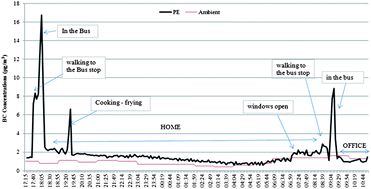
Concentrations of black carbon and nitrogen dioxide have been collected concurrently using a MicrAeth AE-51 and an Aeroqual GSS NO2 sensor. Forty five sampling events with a duration spanning between 16 and 22 hours have collected 10 800 5 min data in Birmingham (UK) from July to October 2011. The high temporal resolution database allowed identification of peak exposures and which activities contributed the most to these peaks, such as cooking and commuting. Personal exposure concentrations for non-occupationally exposed subjects ranged between 0.01 and 50 µ)g m-3 for BC with average values of 1.3 ± 2.2 µg m-3 (AM ± SD). Nitrogen dioxide exposure concentrations were in the range <LOD to 800 ppb with average concentrations of 23 ± 50 ppb. The correlation between personal exposures (PEs) and central site (A) concentrations was evaluated, with only NO2 exposures averaged over the sampling event significantly correlating with central site levels. The PE/A ratio ranged between 1.1 (BC) and 0.2-0.7 (NO2) in the absence of combustion sources to 13 (BC) for subjects commuting in trains and 2.9 (NO2) for subjects cooking with gas appliances.
Fetching data from CrossRef. This may take some time to load.
Journal of Environmental Monitoring
- Information Point
This text is added as a work around for heading error in Accessibility testing