


 PLATFORM UPDATE:

Concentrated solar thermoelectric generators†
Abstract
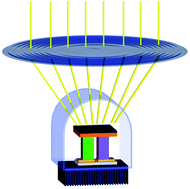
Solar thermoelectric generators (STEGs) are solid state heat engines that generate electricity from concentrated sunlight. In this paper, we develop a novel detailed balance model for STEGs and apply this model to both state-of-the-art and idealized materials. This model uses thermoelectric compatibility theory to provide analytic solutions to device efficiency in idealized materials with temperature-dependent properties. The results of this modeling allow us to predict maximum theoretical STEG efficiencies and suggest general design rules for STEGs. With today's materials, a STEG with an incident flux of 100 kW m−2 and a hot side temperature of 1000 °C could achieve 15.9% generator efficiency, making STEGs competitive with concentrated solar power plants. Future developments will depend on materials that can provide higher operating temperatures or higher material efficiency. For example, a STEG with zT = 2 at 1500 °C would have an efficiency of 30.6%.
 Please wait while we load your content...


