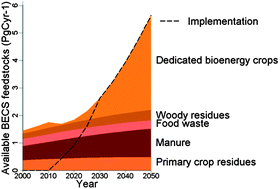
We assess the quantitative potential for future land management to help rebalance the global carbon cycle by actively removing carbon dioxide (CO2) from the atmosphere with simultaneous bio-energy offsets of CO2 emissions, whilst meeting global food demand, preserving natural ecosystems and minimising CO2 emissions from land use change. Four alternative future scenarios are considered out to 2050 with different combinations of high or low technology food production and high or low meat diets. Natural ecosystems are protected except when additional land is necessary to fulfil the dietary demands of the global population. Dedicated bio-energy crops can only be grown on land that is already under management but is no longer needed for food production. We find that there is only room for dedicated bio-energy crops if there is a marked increase in the efficiency of food production (sustained annual yield growth of 1%, shifts towards more efficient animals like pigs and poultry, and increased recycling of wastes and residues). If there is also a return to lower meat diets, biomass energy with carbon storage (BECS) as CO2 and biochar could remove up to 5.2 Pg C per year in 2050 and lower atmospheric CO2 in 2050 by 25 ppm. With the current trend to higher meat diets there is only room for limited expansion of bio-energy crops after 2035 and instead BECS must be based largely on biomass residues, removing up to 3.6 Pg C per year in 2050 and lowering atmospheric CO2 in 2050 by 13 ppm. A high-meat, low-efficiency future would be a catastrophe for natural ecosystems (and thus for the humans that depend on their services) with around 9.3 Gha under cultivation in 2050 and a net increase in atmospheric CO2 in 2050 by 55 ppm due to land use changes. We conclude that future improvements in agricultural efficiency, especially in the livestock sector, could make a decisive contribution to tackling climate change, but this would be maximised if the global trend towards more meat intensive diets can be reversed.
You have access to this article
 Please wait while we load your content...
Something went wrong. Try again?
Please wait while we load your content...
Something went wrong. Try again?


 SCHEDULED MAINTENANCE