This website uses cookies to give you the best user experience. If you continue
without changing your settings we'll assume you are happy to receive all RSC cookies.
You can change your cookie settings by navigating to our Privacy and Cookies page and following the instructions. These instructions
are also obtainable from the privacy link at the bottom of any RSC page.
A journal linking all aspects of the chemical, physical and biotechnological sciences relating to energy conversion and storage, alternative fuel technologies and environmental science.
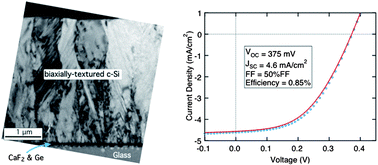
We grow biaxially textured heteroepitaxial crystal silicon (c-Si) films on display glass as a low-cost photovoltaic material. We first fabricate textured CaF2 seed layers using ion-beam assisted deposition, then coat the CaF2 with a thin, evaporated epitaxial Ge buffer and finally deposit heteroepitaxial silicon on the Ge. The silicon is grown by hot-wire chemical vapor deposition, a high-rate, scalable epitaxy technology. Electron and X-ray diffraction confirm the biaxial texture of the CaF2 and epitaxial growth of the subsequent layers. Transmission electron microscopy reveals columnar silicon grains about 500 nm across. We fabricate a proof-of-concept epitaxial film c-Si solar cell with an open circuit voltage of 375 mV that is limited by minority carrier lifetime.
Fetching data from CrossRef. This may take some time to load.
Energy & Environmental Science
- Information Point