
This website uses cookies to give you the best user experience. If you continue
without changing your settings we'll assume you are happy to receive all RSC cookies.
You can change your cookie settings by navigating to our Privacy and Cookies page and following the instructions. These instructions
are also obtainable from the privacy link at the bottom of any RSC page.
A journal linking all aspects of the chemical, physical and biotechnological sciences relating to energy conversion and storage, alternative fuel technologies and environmental science.
Faculty of Engineering, China University of Geosciences, Wuhan, China
E-mail: nflzx@cug.edu.cn
; Fax: +86 2767883507
; Tel: +86 18963963512
b
Faculty of Engineering, China University of Geosciences, Wuhan, China
E-mail: chu05@163.com
; Fax: +86 2767883504
; Tel: +8613554406012
c
Department of Chemistry, Norwegian University of Science and Technology, Trondheim, Norway
E-mail: signe.kjelstrup@nt.ntnu.no
; Fax: +47 73550788
; Tel: +47 73594179
d
Process & Energy Laboratory, Delft University of Technology, Delft, the Netherlands
E-mail: t.j.h.vlugt@tudelft.nl
; Tel: +31 15(0) 2787551
e
Department of Chemistry, Norwegian University of Science and Technology, Trondheim, Norway
E-mail: kirill.glavatskiy@nt.ntnu.no
; Tel: +47 47244779
Energy Environ. Sci., 2012,5, 6779-6795
DOI:
10.1039/C2EE03435B
Received
11 Dec 2011,
Accepted
08 Feb 2012
First published online
08 Feb 2012
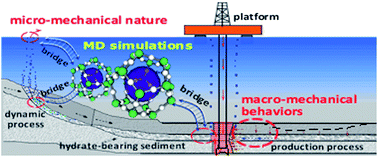
Knowledge of the mechanical properties of clathrate hydrates is central for studying the mechanical properties of hydrate-bearing sediments, their associated applications in wellbore stability, exploitation in stratum deformation, geological disaster prevention, and risk assessment of CO2 buried in oceans. However, because of the limited understanding of hydrate formation conditions and limited methods to investigate these, the understanding of the mechanical properties of hydrates is still poor and even controversial to some extent. This paper reviews current experimental and theoretical results on mechanical properties of hydrates, and discusses the typical difficulties faced in this area. On the experimental side, the most important problem is obtaining pure hydrate samples. Theoretically, the essential origin of the mechanical properties has not been explained in terms of molecular interactions. The hope is to resolve these issues by combining novel macroscopic experiments and microscopic methods. In order to avoid difficulties caused by impurities, it is proposed to use molecular dynamics simulations. This technique can be used to reveal the nature of the mechanical characteristics of hydrates at the molecular and nanometre scale. The goals of this paper are to establish a bridge between the micromechanical nature and the macromechanical properties of hydrates, and to lay a solid theoretical basis for the study of the mechanical properties of hydrate-bearing sediments. These goals are important for the future safe and efficient exploitation of natural hydrates, hydrate-induced seabed geological disaster prevention, the safety of CO2 geological burial, and the deployment of a reliable long-term seabed-borehole coupled hydrate observation system in the integrated Ocean Drilling Program.
Fetching data from CrossRef. This may take some time to load.
Energy & Environmental Science
- Information Point