This website uses cookies to give you the best user experience. If you continue
without changing your settings we'll assume you are happy to receive all RSC cookies.
You can change your cookie settings by navigating to our Privacy and Cookies page and following the instructions. These instructions
are also obtainable from the privacy link at the bottom of any RSC page.
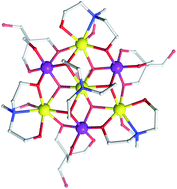
The synthesis, structures and magnetic properties of two new mixed-valence heptanuclear manganese clusters are described. Both complexes utilize triethanolamine (teaH3) as a bridging ligand, displaying near planar, disc-like metal topologies and are of formulae [MnII4MnIV3(tea)(teaH2)3(peolH)4](BF4)2·solv (1) and [MnII4MnIII3F3(tea)(teaH)(teaH2)2(piv)4(Hpiv)(chp)3]·0.5MeCN (2). Compound 1 is a rare mixed-valence compound containing MnII and MnIV ions only and is the first example of a heptanuclear disc with a {MnII4MnIV3} oxidation state distribution. Compound 2 is a {MnII4MnIII3} complex and displays a unique arrangement of oxidation states within the disc, when compared to other known {MnII4MnIII3} examples. Variable temperature DC and AC magnetic susceptibility studies were carried out for 1 and 2 in the 2–300 K temperature range. Compound 1 displayed an increase in the χMT susceptibility values as the temperature is decreased indicating dominant ferromagnetic interactions are present within the cluster. Fits of the χMT vs. T data reveals an S = 23/2 ground state, with several close lying excited states within 1 cm−1. Compound 2 displays an overall decrease in the χMT value as the temperature is decreased down to 2 K indicating dominant antiferromagnetic interactions present with a probable S = 4 ground state as determined from the DC and AC susceptibility data.
Fetching data from CrossRef. This may take some time to load.