This website uses cookies to give you the best user experience. If you continue
without changing your settings we'll assume you are happy to receive all RSC cookies.
You can change your cookie settings by navigating to our Privacy and Cookies page and following the instructions. These instructions
are also obtainable from the privacy link at the bottom of any RSC page.
Department of Environmental Nano-materials, Research Center for Eco-Environmental Sciences, Chinese Academy of Sciences, Beijing 100085, P. R. China
E-mail: zpinghao@rcees.ac.cn
; Fax: +86-10-62923564
; Tel: +86-10-62923564
b
Beijing University Chemical Technology, State Key Laboratory Chemical Resource Engineering, Beijing 100029, P. R. China
E-mail: liuzm@mail.buct.edu.cn
; Fax: +86-10-64427356
; Tel: +86-10-64427356
Catal. Sci. Technol., 2012,2, 1249-1258
DOI:
10.1039/C2CY00465H
Received
16 Nov 2011,
Accepted
24 Feb 2012
First published online
27 Feb 2012
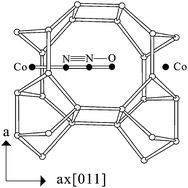
A series of Co exchanged zeolites with ZSM-5, BEA, MOR and USY structures were prepared and investigated for N2O catalytic decomposition under identical reaction conditions. It is found that Co-zeolites with different structures show dramatically different catalytic activities, which could be attributed to various Co species formed in them. Co-ZSM-5, Co-BEA and Co-MOR exhibit much higher activities than Co-USY catalysts, which is attributed to the predominant formation of active isolated Co2+ ions in the ion exchange positions; while in Co-USY Co mainly exists as less active Co oxides. Moreover, it is observed that the activities of Co2+ ions in ZSM-5, BEA and MOR zeolites are quite different and are related to the specific Co ion sites presented in each zeolite structure. In Co-ZSM-5, the most active sites are the α-type Co ions, which are weakly coordinated to framework oxygens in the straight channel. On the other hand, in Co-BEA and Co-MOR, the most active sites are β-type Co ions, which are coordinated to the framework oxygens of the elongated six-membered ring of BEA and the interconnected small channel of MOR, respectively. The main factors affecting the activities of these individual Co ions are indicated to be their location in the zeolite structure, their chemical coordination and the distances between the Co ions. The highest activity of the α-type Co ions in ZSM-5 could be attributed to their favorite location in the zeolite and weak coordination to framework oxygens, which make them easily accessible and coordinated to reactants. The large number of β-sites and their structural arrangement in MOR allow the formation of two unique adjacent β-Co ions in Co–Co pairs, which cooperate in N2O splitting, consequently yielding the high activity of β-Co ions in MOR.
Fetching data from CrossRef. This may take some time to load.
Catalysis Science & Technology
- Information Point