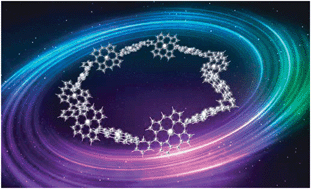
Since highly symmetric cyclic architecture of light-harvesting antenna complex LH2 in purple bacteria was revealed in 1995, there has been a renaissance in developing cyclic porphyrin arrays to duplicate natural systems in terms of high efficiency, in particular, in transferring excitation energy. This tutorial review highlights the mechanisms and rates of excitation energy transfer (EET) in a variety of synthetic cyclic porphyrin arrays on the basis of time-resolved spectroscopic measurements performed at both ensemble and single-molecule levels. Subtle change in structural parameters such as connectivity, distance, and orientation between neighboring porphyrin moieties exquisitely modulates not only the nature of interchromophoric interactions but also the rates and efficiencies of EET. The relationship between the structure and EET dynamics described here should assist a rational design of novel cyclic porphyrin arrays, more contiguous to real applications in artificial photosynthesis.
You have access to this article
 Please wait while we load your content...
Something went wrong. Try again?
Please wait while we load your content...
Something went wrong. Try again?