


Abstract
Origins of life studies represent an exciting and highly multidisciplinary research field. In this review we focus on the contributions made by theory, modelling and simulation to addressing fundamental issues in the domain and the advances these approaches have helped to make in the field. Theoretical approaches will continue to make a major impact at the “systems chemistry” level based on the analysis of the remarkable properties of nonlinear catalytic chemical reaction networks, which arise due to the auto-catalytic and cross-catalytic nature of so many of the putative processes associated with self-replication and self-reproduction. In this way, we describe inter alia nonlinear kinetic models of RNA replication within a primordial Darwinian soup, the origins of homochirality and homochiral polymerization. We then discuss state-of-the-art computationally-based molecular modelling techniques that are currently being deployed to investigate various scenarios relevant to the origins of life.
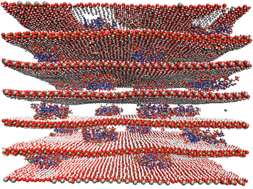
- This article is part of the themed collection: Prebiotic chemistry
 Please wait while we load your content...


