


Assays for human telomerase activity: progress and prospects
Abstract
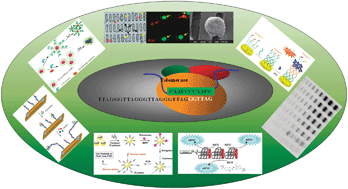
Human telomerase is a ribonucleoprotein complex that functions as a telomere terminal transferase by adding multiple TTAGGG hexamer repeats using its integral RNA as the template. There is a very strong association between telomerase activity and malignancy in nearly all types of cancer, suggesting that telomerase could be used not only as a diagnostic and prognostic marker but also as a therapeutic target for managing cancer. The significant progress in biomedical telomerase research has necessitated the development of new bioanalytical methods for the rapid, sensitive, and reliable detection of telomerase activity in a particular cell or clinical tissue and body fluids. In this review, we highlight some of the latest methods for identifying telomerase activity and inhibition and discuss some of the challenges for designing innovative telomerase assays. We also summarise the current technologies and speculate on future directions for telomerase testing.
 Please wait while we load your content...


