


 SCHEDULED MAINTENANCE

Applications of dewetting in micro and nanotechnology
Abstract
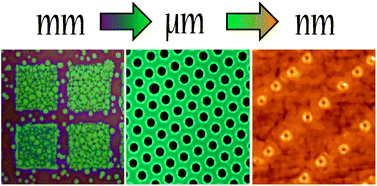
Dewetting is a spontaneous phenomenon where a thin film on a surface ruptures into an ensemble of separated objects, like droplets, stripes, and pillars. Spatial correlations with characteristic distance and object size emerge spontaneously across the whole dewetted area, leading to regular motifs with long-range order. Characteristic length scales depend on film thickness, which is a convenient and robust technological parameter. Dewetting is therefore an attractive paradigm for organizing a material into structures of well-defined micro- or nanometre-size, precisely positioned on a surface, thus avoiding lithographical processes. This tutorial review introduces the reader to the physical–chemical basis of dewetting, shows how the dewetting process can be applied to different functional materials with relevance in technological applications, and highlights the possible strategies to control the length scales of the dewetting process.
 Please wait while we load your content...


