


 SCHEDULED MAINTENANCE

Organocatalysis with dendrimers
Abstract
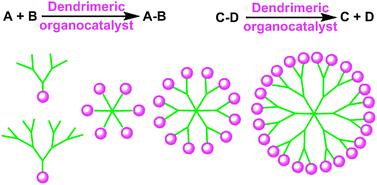
This review gives an overview of the use of dendrimers and dendrons as organocatalysts, i.e. as catalysts in the absence of any metal. A large variety of dendrimeric structures have already been used for such a purpose, varying in size (generation), type and location (core or surface) of the organocatalytic entities, and overall chemical composition. The main types of reactions catalyzed concern bond formation (in particular C–C bonds), bond cleavage (in particular of esters), reductions and oxidations. In many cases, good to excellent enantioselectivities have been observed, in some cases associated with a positive dendritic effect (better properties when the generation of the dendrimer increases). Due to their large size compared to products, the dendrimeric organocatalysts can be often recovered and reused several times.
 Please wait while we load your content...


