


Prebiotic-like chemistry on Titan†
Abstract
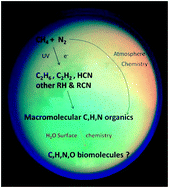
Titan, the largest satellite of Saturn, is the only one in the solar system with a dense atmosphere. Mainly composed of dinitrogen with several % of methane, this atmosphere experiences complex organic processes, both in the gas and aerosol phases, which are of prebiotic interest and within an environment of astrobiological interest. This tutorial review presents the different approaches which can be followed to study such an exotic place and its chemistry: observation, theoretical modeling and experimental simulation. It describes the Cassini–Huygens mission, as an example of observational tools, and gives the new astrobiologically oriented vision of Titan which is now available by coupling the three approaches. This includes the many analogies between Titan and the Earth, in spite of the much lower temperature in the Saturn system, the complex organic chemistry in the atmosphere, from the gas to the aerosol phases, but also the potential organic chemistry on Titan's surface, and in its possible internal water ocean.
- This article is part of the themed collection: Prebiotic chemistry
 Please wait while we load your content...


