


 SCHEDULED MAINTENANCE

Phosphino-carboxamides: the inconspicuous gems
Abstract
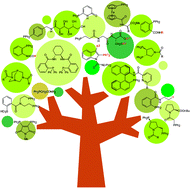
Compounds combining phosphine and carboxamide moieties in their molecules have developed virtually unnoticed into a specific class of highly structurally versatile and tuneable donor molecules finding manifold use in various fields, particularly in coordination chemistry, biomedical sciences and in catalysis. In the latter field, some phosphinoamides became the real privileged ligands and an indispensable part of a standard toolbox for synthetic chemists. This critical review aims to give an overview of the multifaceted chemistry of such compounds, paying attention to both the fundamentals and recent developments in this continuously expanding field.
 Please wait while we load your content...


