This website uses cookies to give you the best user experience. If you continue
without changing your settings we'll assume you are happy to receive all RSC cookies.
You can change your cookie settings by navigating to our Privacy and Cookies page and following the instructions. These instructions
are also obtainable from the privacy link at the bottom of any RSC page.
Department of Chemical Physics, Weizmann Institute of Science, Rehovot, Israel
E-mail: Shimon.Vega@weizmann.ac.il
; Fax: +972-8-9344482
; Tel: +972-8-9342417
Phys. Chem. Chem. Phys., 2012,14, 5729-5743
DOI:
10.1039/C2CP23915A
Received
07 Dec 2011,
Accepted
08 Feb 2012
First published online
14 Mar 2012
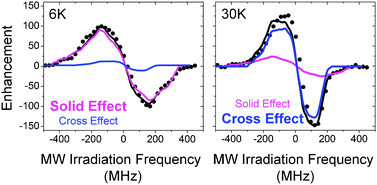
Proton Dynamic Nuclear Polarization (DNP) experiments were conducted on a 3.4 T homebuilt hybrid pulsed-EPR-NMR spectrometer, on static samples containing 10 mM or 40 mM TEMPOL in frozen glassy solutions of DMSO/water. During DNP experiments proton-NMR signals are enhanced with the help of microwave (MW) irradiation on or close to the Electron Paramagnetic Resonance (EPR) spectrum of the free radicals in the sample, transferring polarization from the free electrons to the nuclei. In the solid state a distinction is made between three DNP enhancement mechanisms: the Solid Effect (SE), the Cross Effect (CE) and Thermal Mixing (TM). In an effort to determine the dominant DNP mechanisms responsible for the enhancement of the nuclear signals, electron and nuclear spin–lattice relaxation rates, enhancement buildup times and microwave (MW) swept DNP spectra were measured as a function of temperature and MW irradiation strength. We observed lineshape variations of the DNP spectra that indicated changes in the relative contributions of SE-DNP and CE-DNP with temperature and MW power. Using a theoretical model describing the SE-DNP and CE-DNP the DNP spectra could be analyzed without involving the TM-DNP mechanism and the relative SE-DNP and CE-DNP contributions to the nuclear enhancement could be determined. From this analysis it follows that lowering the temperature beyond 20 K increases the SE-DNP and decreases the CE-DNP contributions. Possible explanations for this behavior are suggested.
Fetching data from CrossRef. This may take some time to load.
Physical Chemistry Chemical Physics
- Information Point