This website uses cookies to give you the best user experience. If you continue
without changing your settings we'll assume you are happy to receive all RSC cookies.
You can change your cookie settings by navigating to our Privacy and Cookies page and following the instructions. These instructions
are also obtainable from the privacy link at the bottom of any RSC page.
Department of Materials Science and Engineering, Faculty of Engineering, NUSNNI-NanoCore, National University of Singapore, Singapore
E-mail: qing.wang@nus.edu.sg
; Tel: +65 6516-7118
Phys. Chem. Chem. Phys., 2012,14, 7367-7374
DOI:
10.1039/C2CP40551B
Received
22 Feb 2012,
Accepted
03 Apr 2012
First published online
04 Apr 2012
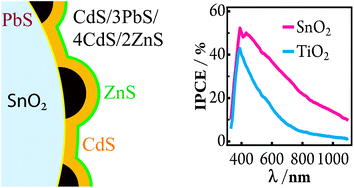
Metal oxide semiconductors with lower lying conduction band minimum and superior electron mobility are essential for efficient charge separation and collection in PbS-sensitized solar cells. In the present study, mesoscopic SnO2 was investigated as an alternative photoanode to the commonly used TiO2 and examined comprehensively in PbS-sensitized liquid junction solar cells. To exploit the capability of PbS in an optimized structure, cascaded nPbS/nCdS and alternate n(PbS/CdS) layers deposited by a successive ionic layer adsorption and reaction method were systematically scrutinized. It was observed that the surface of SnO2 has greater affinity to the growth of PbS compared with TiO2, giving rise to much enhanced light absorption. In addition, the deposition of a CdS buffer layer and a ZnS passivation layer before and after a PbS layer was found to be beneficial for efficient charge separation. Under optimized conditions, cascaded PbS/CdS-sensitized SnO2 exhibited an unprecedented photocurrent density of 17.38 mA cm−2 with pronounced infrared light harvesting extending beyond 1100 nm, and a power conversion efficiency of 2.23% under AM 1.5, 1 sun illumination. In comparison, TiO2 cells fabricated under similar conditions showed much inferior performance owing to the less efficient light harnessing of long wavelength photons. We anticipate that the systematic study of PbS-sensitized solar cells utilizing different metal oxide semiconductors as electron transporters would provide useful insights and promote the development of semiconductor-sensitized mesoscopic solar cells employing panchromatic sensitizers.
Fetching data from CrossRef. This may take some time to load.
Physical Chemistry Chemical Physics
- Information Point