This website uses cookies to give you the best user experience. If you continue
without changing your settings we'll assume you are happy to receive all RSC cookies.
You can change your cookie settings by navigating to our Privacy and Cookies page and following the instructions. These instructions
are also obtainable from the privacy link at the bottom of any RSC page.
Canada Research Chair in Scientific Modeling and Simulation, Department of Chemistry and Department of Physics and Physical Oceanography, Memorial University of Newfoundland, 283 Prince Philip Drive, St. John's, Canada
E-mail: paul.mezey@gmail.com
; Fax: 1 709 864 3702
; Tel: 1 709 749 8768
Phys. Chem. Chem. Phys., 2012,14, 8516-8522
DOI:
10.1039/C2CP40237H
Received
23 Jan 2012,
Accepted
27 Apr 2012
First published online
27 Apr 2012
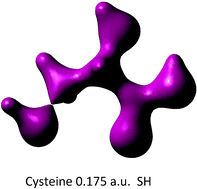
One of the tools of the shape analysis of molecular electron densities, the Density Threshold Progression Approach used in Shape Group studies can also serve as a criterion for the selection of “natural” molecular fragments, relevant to functional group comparisons, reactivity studies, as well as to the study of levels of relative “autonomy” of various molecular regions. The relevance of these approaches to the fragment-based studies of large molecules, such as biopolymers and nanostructures is emphasized, and the constraints represented by the holographic electron density theorem to this and alternative recent fragment approaches are discussed. The analogies with potential energy hypersurface analysis using the Energy Threshold Progression Approach and connections to level set methods are discussed, and the common features of these seemingly distant problems are described.
Fetching data from CrossRef. This may take some time to load.
Physical Chemistry Chemical Physics
- Information Point