This website uses cookies to give you the best user experience. If you continue
without changing your settings we'll assume you are happy to receive all RSC cookies.
You can change your cookie settings by navigating to our Privacy and Cookies page and following the instructions. These instructions
are also obtainable from the privacy link at the bottom of any RSC page.
Chemical Physics Theory Group, Department of Chemistry, University of Toronto, Toronto, Canada
E-mail: rkapral@chem.utoronto.ca
; Fax: +1-416-9785325
; Tel: +1-416-9786106
b
CeSiMo, Facultad de Ingeniería. Universidad de Los Andes, Mérida 5101, Venezuela
E-mail: cecheve@ula.ve
Phys. Chem. Chem. Phys., 2012,14, 6755-6763
DOI:
10.1039/C2CP40200A
Received
19 Jan 2012,
Accepted
15 Mar 2012
First published online
15 Mar 2012
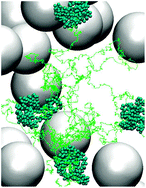
The effects of molecular crowding on the enzymatic conformational dynamics and transport properties of adenylate kinase are investigated. This tridomain protein undergoes large scale hinge motions in the course of its enzymatic cycle and serves as prototype for the study of crowding effects on the cyclic conformational dynamics of proteins. The study is carried out at a mesoscopic level where both the protein and the solvent in which it is dissolved are treated in a coarse grained fashion. The amino acid residues in the protein are represented by a network of beads and the solvent dynamics is described by multiparticle collision dynamics that includes effects due to hydrodynamic interactions. The system is crowded by a stationary random array of hard spherical objects. Protein enzymatic dynamics is investigated as a function of the obstacle volume fraction and size. In addition, for comparison, results are presented for a modification of the dynamics that suppresses hydrodynamic interactions. Consistent with expectations, simulations of the dynamics show that the protein prefers a closed conformation for high volume fractions. This effect becomes more pronounced as the obstacle radius decreases for a given volume fraction since the average void size in the obstacle array is smaller for smaller radii. At high volume fractions for small obstacle radii, the average enzymatic cycle time and characteristic times of internal conformational motions of the protein deviate substantially from their values in solution or in systems with small density of obstacles. The transport properties of the protein are strongly affected by molecular crowding. Diffusive motion adopts a subdiffusive character and the effective diffusion coefficients can change by more than an order of magnitude. The orientational relaxation time of the protein is also significantly altered by crowding.
Fetching data from CrossRef. This may take some time to load.
Physical Chemistry Chemical Physics
- Information Point