This website uses cookies to give you the best user experience. If you continue
without changing your settings we'll assume you are happy to receive all RSC cookies.
You can change your cookie settings by navigating to our Privacy and Cookies page and following the instructions. These instructions
are also obtainable from the privacy link at the bottom of any RSC page.
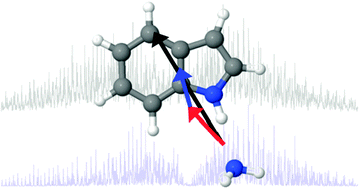
Hydrogen bond pairs involving the chromophore indole have been extensively studied in the gas phase. Here, we report high resolution electronic spectroscopy experiments on the indole–NH3 hydrogen bond pair in the absence and presence of an electric field. The S1–S0 origin band of this complex recorded in zero field at high resolution reveals two overlapping spectra; a consequence of NH3 hindered internal rotation. The barrier to internal rotation is predicted by theory to be less than 20 cm−1 in the ground state, therefore requiring a non-rigid rotor Hamiltonian to interpret the spectra. Conducting the experiment in the presence of an applied electric field further perturbs the already congested spectrum of the complex, but makes possible the measurement of the permanent electric dipole moments in its S0 and S1 states. These values reveal significant changes in electron distribution that arise from hydrogen bonding effects.
Fetching data from CrossRef. This may take some time to load.
Physical Chemistry Chemical Physics
- Information Point