This website uses cookies to give you the best user experience. If you continue
without changing your settings we'll assume you are happy to receive all RSC cookies.
You can change your cookie settings by navigating to our Privacy and Cookies page and following the instructions. These instructions
are also obtainable from the privacy link at the bottom of any RSC page.
Faculty of Physics, Adam Mickiewicz University, 61-614 Poznań, Poland
E-mail: msb@amu.edu.pl
; Fax: +4861 8295155
; Tel: +4861 8295202
b
Department of Chemical and Biomolecular Engineering, North Carolina State University, Raleigh, USA
E-mail: keg@ncsu.edu
; Fax: 919 513 2470
; Tel: 1 919 513 0481
Phys. Chem. Chem. Phys., 2012,14, 7145-7153
DOI:
10.1039/C2CP22111J
Received
07 Mar 2012,
Accepted
20 Mar 2012
First published online
10 Apr 2012
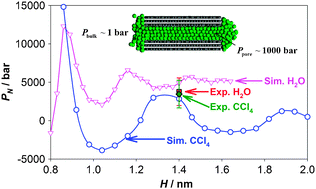
We report X-ray diffraction studies of water and carbon tetrachloride adsorbed in nanoporous activated carbon fibres. The fibres are built of turbostratic nanoparticles separated by quasi two-dimensional voids, forming narrow slit-shaped pores. In order to determine the structure of water within the pores and its influence on the fibres' structure, mean interatomic and intermolecular distances have been estimated from the positions of the maxima of the normalized angular distribution functions obtained by X-ray diffraction. We observe a cluster arrangement of the water molecules, as well as significant changes in the interlayer distance of the carbon nanoparticles upon adsorption of both water and carbon tetrachloride. The results suggest that very high pressures arise within the pores, as has been observed in molecular simulations, and this may give rise to the large change in electronic properties of the fibres after adsorption of guest molecules. The in-pore pressure normal to the pore walls is estimated from the experimental data, and is found to be positive and of the order 4000 bar. Molecular simulation results for the normal pressure component are presented for both water and carbon tetrachloride in carbon slit pores, and are in general agreement with the experiments. For both fluids the normal pressure is an oscillating function of pore width.
Fetching data from CrossRef. This may take some time to load.
Physical Chemistry Chemical Physics
- Information Point