This website uses cookies to give you the best user experience. If you continue
without changing your settings we'll assume you are happy to receive all RSC cookies.
You can change your cookie settings by navigating to our Privacy and Cookies page and following the instructions. These instructions
are also obtainable from the privacy link at the bottom of any RSC page.
KLGHEI of Environment and Energy Chemistry, School of Chemistry and Chemical Engineering, Sun Yat-sen University, Guangzhou, P. R. China
E-mail: cesclp@mail.sysu.edu.cn (L. Chen)
; Fax: +86 20 8411 2245
; Tel: +86 20 8411 5559
b
State Key Laboratory of Optoelectronic Materials and Technologies, School of Physics and Engineering, Sun Yat-Sen University, Guangzhou, P. R. China
E-mail: stsspk@mail.sysu.edu.cn
; Fax: +86 20 84036736
; Tel: +86 20 84113369
CrystEngComm, 2012,14, 4279-4283
DOI:
10.1039/C2CE25130B
Received
27 Jan 2012,
Accepted
02 Apr 2012
First published online
02 Apr 2012
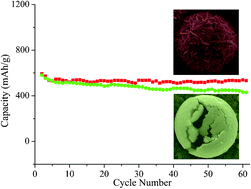
SnS2 hollow microspheres and SnS2 3D nanoflake-based hollow microspheres are successfully synthesized via a one-step hydrothermal process. From the experimental results, a mechanism based on bubble-templating, self-assembling and subsequent shell evolution was proposed. These hollow spheres were tested as anode materials in lithium ion batteries (LIBs) and found to have good cycling performance. This article provide a facile strategy to prepare hollow structures and give some insight studies on their applications in lithium ion storage and retrieval.
Fetching data from CrossRef. This may take some time to load.