


 SCHEDULED MAINTENANCE

Microwave accelerated Glaser–Hay macrocyclizations at high concentrations†
Abstract
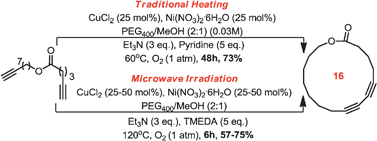
Efficient macrocyclization can be conducted at high concentrations employing microwave irradiation and a phase separation strategy. The rate of the Glaser–Hay macrocyclization is accelerated using microwave irradiation and reaction times decreased from 48 h to 1–6 h, depending on the nature of the substrate. Macrocyclization concentrations could be increased up to 0.1 M compared to traditional concentrations (0.2 mM).
 Please wait while we load your content...


