This website uses cookies to give you the best user experience. If you continue
without changing your settings we'll assume you are happy to receive all RSC cookies.
You can change your cookie settings by navigating to our Privacy and Cookies page and following the instructions. These instructions
are also obtainable from the privacy link at the bottom of any RSC page.
Centre for Education, Electrodics and Electrocatalysis Division, CSIR-Central Electrochemical Research Institute, Karaikudi - 630006, India
E-mail: sowmitheivam@gmail.com
; Fax: +91 4565-227779
; Tel: +91 4565-241340
b
Electrodics and Electrocatalysis Division, CSIR-Central Electrochemical Research Institute, Karaikudi - 630006, India
E-mail: almathi@cecri.res.in
; Fax: +91 4565-227779
; Tel: +91 4565-241340
Anal. Methods, 2012,4, 1838-1842
DOI:
10.1039/C2AY25215E
Received
01 Mar 2012,
Accepted
23 Mar 2012
First published online
27 Mar 2012
In this work, we explored the possibility of developing an enzymatic potentiometric glucose biosensor using polyaniline–camphorsulfonic acid–glucose oxidase (PANI–CSA–GOD) composite films. Glucose oxidase was covalently immobilized on the polyaniline–camphorsulfonic acid modified electrode that was used as a potentiometric sensor matrix. The PANI–CSA–GOD transducer responded linearly to glucose molecules in the concentration range of 1 to 50 mM and the sensitivity was found to be 0.09 mV mM−1. The modified electrode showed excellent sensitivity and better selectivity in the presence of some common interfering molecules.
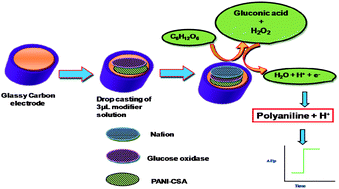
In this work, we explored the possibility of developing an enzymatic potentiometric glucose biosensor using polyaniline-camphorsulfonic acid-glucose oxidase (PANI-CSA-GOD) composite films. Glucose oxidase was covalently immobilized on the polyaniline-camphorsulfonic acid modified electrode that was used as a potentiometric sensor matrix. The PANI-CSA-GOD transducer responded linearly to glucose molecules in the concentration range of 1 to 50 mM and the sensitivity was found to be 0.09 mV mM–1. The modified electrode showed excellent sensitivity and better selectivity in the presence of some common interfering molecules.
Fetching data from CrossRef. This may take some time to load.