This website uses cookies to give you the best user experience. If you continue
without changing your settings we'll assume you are happy to receive all RSC cookies.
You can change your cookie settings by navigating to our Privacy and Cookies page and following the instructions. These instructions
are also obtainable from the privacy link at the bottom of any RSC page.
A whole cell based amperometric biosensor was fabricated using unicellular microalgae Chlorella sp. as the biocatalyst, entrapped in a polymeric membrane directly interfaced to the surface of a platinum electrode for the detection of bioavailable heavy metal ions like zinc, copper, cadmium, cobalt and nickel with a life time of 7 days. The proposed system is sensitive to a lower concentration range of 10−9 M of nickel ions, 10−10 M of cadmium and cobalt ions, 10−11 M of copper and zinc ions. The amperometric biosensor responds to heavy metal ions with a relative selectivity in the order: Zn2+ > Cu2+ > Cd2+ > Co2+ > Ni2+. The proposed analytical method has been validated with atomic absorption spectroscopy for heavy metal detection in real time samples.
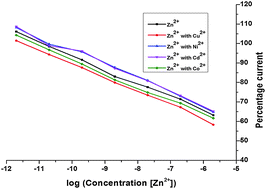
A whole cell based amperometric biosensor was fabricated using unicellular microalgae Chlorella sp. as the biocatalyst, entrapped in a polymeric membrane directly interfaced to the surface of a platinum electrode for the detection of bioavailable heavy metal ions like zinc, copper, cadmium, cobalt and nickel with a life time of 7 days. The proposed system is sensitive to a lower concentration range of 10–9 M of nickel ions, 10–10 M of cadmium and cobalt ions, 10–11 M of copper and zinc ions. The amperometric biosensor responds to heavy metal ions with a relative selectivity in the order: Zn2+ > Cu2+ > Cd2+ > Co2+ > Ni2+. The proposed analytical method has been validated with atomic absorption spectroscopy for heavy metal detection in real time samples.
Fetching data from CrossRef. This may take some time to load.