This website uses cookies to give you the best user experience. If you continue
without changing your settings we'll assume you are happy to receive all RSC cookies.
You can change your cookie settings by navigating to our Privacy and Cookies page and following the instructions. These instructions
are also obtainable from the privacy link at the bottom of any RSC page.
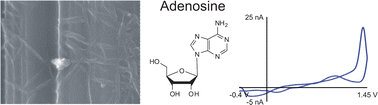
Adenosine is a neuromodulator that regulates neurotransmission. Adenosine can be monitored using fast-scan cyclic voltammetry at carbon-fiber microelectrodes and ATP is a possible interferent in vivo because the electroactive moiety, adenine, is the same for both molecules. In this study, we investigated carbon-fiber microelectrodes coated with Nafion and carbon nanotubes (CNTs) to enhance the sensitivity of adenosine and decrease interference by ATP. Electrodes coated in 0.05 mg mL−1 CNTs in Nafion had a 4.2 ± 0.2 fold increase in current for adenosine, twice as large as for Nafion alone. Nafion–CNT electrodes were 6 times more sensitive to adenosine than ATP. The Nafion–CNT coating did not slow the temporal response of the electrode. Comparing different purine bases shows that the presence of an amine group enhances sensitivity and that purines with carbonyl groups, such as guanine and hypoxanthine, do not have as great an enhancement after Nafion–CNT coating. The ribose group provides additional sensitivity enhancement for adenosine over adenine. The Nafion–CNT modified electrodes exhibited significantly more current for adenosine than ATP in brain slices. Therefore, Nafion–CNT modified electrodes are useful for sensitive, selective detection of adenosine in biological samples.
Adenosine is a neuromodulator that regulates neurotransmission. Adenosine can be monitored using fast-scan cyclic voltammetry at carbon-fiber microelectrodes and ATP is a possible interferent in vivo because the electroactive moiety, adenine, is the same for both molecules. In this study, we investigated carbon-fiber microelectrodes coated with Nafion and carbon nanotubes (CNTs) to enhance the sensitivity of adenosine and decrease interference by ATP. Electrodes coated in 0.05 mg mL–1 CNTs in Nafion had a 4.2 ± 0.2 fold increase in current for adenosine, twice as large as for Nafion alone. Nafion-CNT electrodes were 6 times more sensitive to adenosine than ATP. The Nafion-CNT coating did not slow the temporal response of the electrode. Comparing different purine bases shows that the presence of an amine group enhances sensitivity and that purines with carbonyl groups, such as guanine and hypoxanthine, do not have as great an enhancement after Nafion-CNT coating. The ribose group provides additional sensitivity enhancement for adenosine over adenine. The Nafion-CNT modified electrodes exhibited significantly more current for adenosine than ATP in brain slices. Therefore, Nafion-CNT modified electrodes are useful for sensitive, selective detection of adenosine in biological samples.
Fetching data from CrossRef. This may take some time to load.