This website uses cookies to give you the best user experience. If you continue
without changing your settings we'll assume you are happy to receive all RSC cookies.
You can change your cookie settings by navigating to our Privacy and Cookies page and following the instructions. These instructions
are also obtainable from the privacy link at the bottom of any RSC page.
Optical cavities are commonly used to increase the sensitivity of absorption measurements, but have not been extensively used below 300 nm, mainly owing to the limited light sources at these wavelengths. While some progress has been made using cavity ring-down spectroscopy, these systems rely on complex and expensive lasers. Here we investigate an approach combining Cavity-Enhanced Absorption Spectroscopy (CEAS) with an inexpensive low vapour pressure mercury lamp for sensitive absorption measurements at 253.7 nm. We demonstrate that the CEAS absorption in our system is 50 times greater than the absorption found in a single-pass configuration; using this approach, we obtained limits of detection of 8.1 pptv (66 ng m−3) for gaseous elemental mercury and 8.4 ppbv for ozone. We evaluate the performance of the system and discuss potential improvements and applications of this approach.
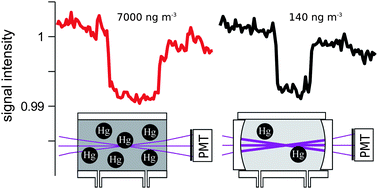
Optical cavities are commonly used to increase the sensitivity of absorption measurements, but have not been extensively used below 300 nm, mainly owing to the limited light sources at these wavelengths. While some progress has been made using cavity ring-down spectroscopy, these systems rely on complex and expensive lasers. Here we investigate an approach combining Cavity-Enhanced Absorption Spectroscopy (CEAS) with an inexpensive low vapour pressure mercury lamp for sensitive absorption measurements at 253.7 nm. We demonstrate that the CEAS absorption in our system is 50 times greater than the absorption found in a single-pass configuration; using this approach, we obtained limits of detection of 8.1 pptv (66 ng m–3) for gaseous elemental mercury and 8.4 ppbv for ozone. We evaluate the performance of the system and discuss potential improvements and applications of this approach.
Fetching data from CrossRef. This may take some time to load.