This website uses cookies to give you the best user experience. If you continue
without changing your settings we'll assume you are happy to receive all RSC cookies.
You can change your cookie settings by navigating to our Privacy and Cookies page and following the instructions. These instructions
are also obtainable from the privacy link at the bottom of any RSC page.
Department of Bioengineering and Department of Mechanical and Aerospace Engineering, University of California, San Diego, La Jolla, USA
E-mail: rlal@ucsd.edu
b
Center for Cancer Research Nanobiology Program, SAIC-Frederick, Inc., NCI-Frederick, Frederick, USA
E-mail: ruthnu@helix.nih.gov
c
Sackler Inst. of Molecular Medicine, Department of Human Genetics and Molecular Medicine, Sackler School of Medicine, Tel Aviv University, Tel Aviv, Israel
Soft Matter, 2011,7, 5267-5273
DOI:
10.1039/C1SM05162H
Received
31 Jan 2011,
Accepted
01 Apr 2011
First published online
09 May 2011
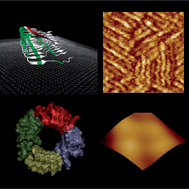
Amyloid-β (Aβ) peptides are thought to be involved in neurodegenerative diseases such as Alzheimer's disease and Down's syndrome. They form a large number of polymorphic structures, including heterogeneous ionic pores in membranes as well as different types of fibrillar and globular structures on surfaces and in solution. Understanding the origin of these structures and the factors that influence their occurrence is of great biomedical interest because of the possible relationship between structure and pathogenicity. Here, we use atomic force microscopy (AFM) and molecular dynamics (MD) simulations to demonstrate that at room temperature a truncated Aβpeptide which is generated in vivo and shown to be toxic in vitro forms fibrillar structures on hydrophobic graphite surfaces, but not on hydrophilic mica or lipid bilayers. Our results suggest that the toxic pores and fibrillar polymorphic organizations can be explained in terms of the U-shaped β-strand–turn–β-strand structural motif observed for full length Aβ and other amyloids, as well as the physicochemical properties at the interfaces. The interactions of the hydrophobic, truncated Aβ with its environment illustrate that the universal amyloid motif can provide a link between the pore and fibrillar structures and indicate that surfaces with different physicochemical properties can shift the polymorphic landscape toward other conformational states.
Fetching data from CrossRef. This may take some time to load.