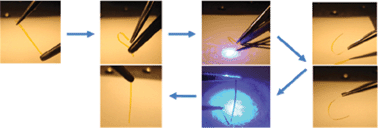
Rapidly reconfigurable, adaptive materials are essential for the realization of “smart”, highly engineered technologies sought by aerospace, medicine, and other application areas. Shape memory observed in metal alloys and polymers (SMPs) is a primary example of shape change (adaptation). To date, nearly all shape adaptations in SMPs have been thermally triggered. A desire for isothermal, remotely cued shape adaptations of SMP has motivated examinations of other stimuli, such as light. Only a few reports document so-called light-activated SMP, in both cases exploiting photoinduced adjustments to the crosslink density of a polymer matrix with UV light of 365 nm (crosslinking) and <260 nm (decrosslinking). This work presents a distinctive approach to generating light-activated SMP by employing a glassy liquid crystal polymer network (LCN) material that is capable of rapid photo-fixing with short exposures (<5 min) of eye-safe 442 nm light. Here, linearly polarized 442 nm light is used to photo-fix temporary states in both cantilever and free-standing geometries which are then thermally or optically restored to the permanent shape. The combination of thermal and photo-fixable shape memory presented here yields substantial functionality in a single adaptive material that could reduce part count in applications. As a demonstration of the opportunities afforded by this functional material, the glassy, photoresponsive LCN is thermally fixed as a catapult and subsequently used to transduce light energy into mechanical work, demonstrated here in the “photo-fueled” launching of an object at a rate of 0.3 m s−1.
You have access to this article
 Please wait while we load your content...
Something went wrong. Try again?
Please wait while we load your content...
Something went wrong. Try again?


 SCHEDULED MAINTENANCE