This website uses cookies to give you the best user experience. If you continue
without changing your settings we'll assume you are happy to receive all RSC cookies.
You can change your cookie settings by navigating to our Privacy and Cookies page and following the instructions. These instructions
are also obtainable from the privacy link at the bottom of any RSC page.
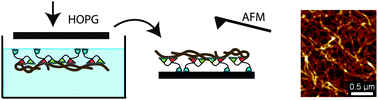
One central problem for the function and manufacture of materials where performance relies on nanoscale structure is to control the compatibility and interactions of the building blocks. In natural materials, such as nacre, there are examples of multifunctional macromolecules that have combined binding affinities for different materials within the same molecule, thereby bridging these materials and acting as a molecular glue. Here, we describe the use of a designed multifunctional protein that is used for self-assembly of nanofibrillar cellulose. Recent advances in the production of cellulose nanofibrils have given inspiration for new uses of cellulosic materials. Cellulose nanofibrils have mechanical and structural features that open new possibilities for performance in composites and other nanoscale materials. Functionalisation was realised through a bi-functional fusion protein having both an ability to bind to cellulose and a second functionality of surface activity. The cellulose-binding function was obtained using cellulose-binding domains from cellulolytic enzymes and the surface activity through the use of a surface active protein called hydrophobin. Using the bi-functional protein, cellulose nanofibrils could be assembled into tightly packed thin films at the air/water interface and at the oil/water interface. It was shown that the combination of protein and cellulose nanofibrils resulted in a synergistic improvement in the formation and stability of oil-in-water emulsions resulting in emulsions that were stable for several months. The bi-functionality of the protein also allowed the binding of hydrophobic solid drugnanoparticles to cellulose nanofibrils and thereby improving their long-term stability under physiological conditions.
Fetching data from CrossRef. This may take some time to load.