This website uses cookies to give you the best user experience. If you continue
without changing your settings we'll assume you are happy to receive all RSC cookies.
You can change your cookie settings by navigating to our Privacy and Cookies page and following the instructions. These instructions
are also obtainable from the privacy link at the bottom of any RSC page.
Physics of Fluids Group, Department of Applied Physics, Faculty of Science and Techonology, Impact & MESA+ Institutes, J. M. Burgers Centre, University of Twente, Enschede, The Netherlands
b
BIOS/Lab-on-a-Chip group, Faculty of Electrical Engineering, Mathematics and Computer Science, University of Twente, Enschede, The Netherlands
Soft Matter, 2011,7, 11325-11333
DOI:
10.1039/C1SM05801K
Received
02 May 2011,
Accepted
05 Jul 2011
First published online
13 Sep 2011
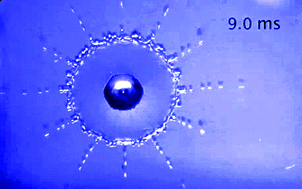
The dynamics of water drop impact at high impinging velocity onto superhydrophobic substrates is experimentally investigated. The solid substrate—comprised of regular and hydrophobic micropillars—is transparent, thereby facilitating close-up, top-or-bottom-view, high-speed imaging. With a sufficient impact velocity, instead of a completely-bouncing “Fakir” droplet, wetting splashing can occur, with an entrapped air bubble at the centre surrounded by a wetted area as well as an emission of satellite droplets during the advancing phase of spreading lamella. A large portion of the lamella travels upon air and subsequently recoils due to surface tension, forming a partial rebound on the central wet spot. We present and discuss quantitative results of the entrapped air bubble, the central wetted area, and the maximal spreading lamella as the impact velocity is increased. We further vary the lattice periodicity of the micro-patterns and find its profound influence on the macroscopic flow. More specifically, directional splashing can emerge, emitting secondary droplets in certain directions which are associated with the lattice. Directional splashing can be suppressed to a gentle spreading by decreasing the periodicity of the lattice and, furthermore, can be tuned to a completely-wetting splashing in the diagonal directions of the lattice by a larger periodicity, offering opportunities to control the wetting process. Finally, the elimination of directional splashing by reducing air pressure suggests that the underlying air is squeezed outwards by the falling droplet upon the solid boundary whereby the air flow is affected, leading to different splashing behavior.
Fetching data from CrossRef. This may take some time to load.