


Mechanised materials
Abstract
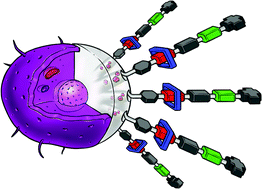
Throughout history, mankind has attempted to mimic the natural world—building wings to fly like the birds and fabricating systems to harness energy from the sun like our botanical brethren. However, on account of the enormous complexity that Nature has accrued over millions of years—more often than not—this imitation has resulted in failure. It was only once systems were developed that sought a looser connection to Nature, rather than attempting to reproduce it in a direct manner, that we were successful in accomplishing our goals. It is tempting to take these lessons we have learned from the macroscopic world and apply them to the nanoscale. Rather than attempting to replicate biological molecular machines capable of performing macroscopic motion, it is important to create a more robust world. In the past two decades, chemists have been synthesizing molecular switches and assembling molecular machines in order to study their properties and understand their function. Just as the artist takes to his or her canvas to create some masterpiece, chemists need to move to surfaces and interfaces in order to illicit function from these advanced integrated systems. In this mini-review we (1) outline several synthetic molecular machines that have been pinned down on surfaces to induce macroscale function and motion and (2) highlight some bioconjugated molecular devices which are capable of harnessing motion. Finally, we reflect upon the concept of appending molecular machinery to biological entities in order to express a range of properties.
 Please wait while we load your content...


