This website uses cookies to give you the best user experience. If you continue
without changing your settings we'll assume you are happy to receive all RSC cookies.
You can change your cookie settings by navigating to our Privacy and Cookies page and following the instructions. These instructions
are also obtainable from the privacy link at the bottom of any RSC page.
Regional Centre of Advanced Technologies and Materials, Department of Inorganic Chemistry, Faculty of Science, Palacký University, 17. listopadu 12, Olomouc, Czech Republic
E-mail: zdenek.travnicek@upol.cz
; Fax: +420585 634 954
; Tel: +420 585 634 352
b
Department of Inorganic Chemistry, Faculty of Science, Palacký University, 17. listopadu 12, Olomouc, Czech Republic
Org. Biomol. Chem., 2011,9, 5703-5713
DOI:
10.1039/C1OB05649B
Received
26 Apr 2011,
Accepted
16 May 2011
First published online
16 May 2011
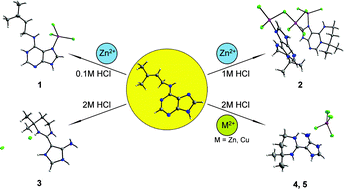
N6-Isopentenyladenine (L1) was subjected to variously acidic media in 0.1 M, 1 M and 2 M HCl. In dependence on the acidity of the medium, the formation of three main acid hydrolysis products, involving the N6-isopentenyladeninium (HL1) (1), 7,8,9,10-tetrahydro-7,7-dimethyl-3H-pyrimido[2,1-i]purin-6-ium (HL2) (2) or 5-amino-4-(4,4-dimethyl-3,4,5,6-tetrahydropyrimidin-2-yl)-imidazolium (H2L3) (3–5) cations, were determined and characterized by multinuclear solution-state NMR spectroscopy and in the solid state by single crystal X-ray analysis. The coordination abilities of these transformation products have been also investigated. The compounds of the compositions [Zn(HL1)Cl3]·H2O (1), [Zn3(HL2)2Cl8] (2), (H2L3)[CuCl4] (4) and (H2L3)[ZnCl4] (5) have been prepared in dependence on the acidity of the medium used by the reactions of L1 with ZnCl2·1.5H2O or CuCl2·2H2O. Based on the NMR spectroscopic and X-ray crystallographic results, the mechanism of transformation of L1 in the acidic medium, involving the protonation, cyclization and ring fission, has been suggested.
Fetching data from CrossRef. This may take some time to load.
This may take some time to load.
Organic & Biomolecular Chemistry
- Information Point