This website uses cookies to give you the best user experience. If you continue
without changing your settings we'll assume you are happy to receive all RSC cookies.
You can change your cookie settings by navigating to our Privacy and Cookies page and following the instructions. These instructions
are also obtainable from the privacy link at the bottom of any RSC page.
Department of Inorganic and Physical Chemistry, Indian Institute of Science, Bangalore 560 012, India
E-mail: mugesh@ipc.iisc.ernet.in
; Fax: (+)91-80-2360 1552/2360 0683
; Tel: (+)91-80- 2360 2566
Org. Biomol. Chem., 2011,9, 5193-5200
DOI:
10.1039/C0OB01234C
Received
22 Dec 2010,
Accepted
20 Apr 2011
First published online
21 Apr 2011
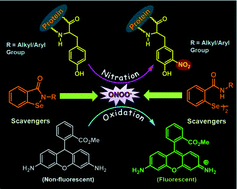
In this study, ebselen and its analogues are shown to be catalysts for the decomposition of peroxynitrite (PN). This study suggests that the PN-scavenging ability of selenenyl amides can be enhanced by a suitable substitution at the phenyl ring in ebselen. Detailed mechanistic studies on the reactivity of ebselen and its analogues towards PN reveal that these compounds react directly with PN to generate highly unstable selenoxides that undergo a rapid hydrolysis to produce the corresponding seleninic acids. The selenoxides interact with nitrite more effectively than the corresponding seleninic acids to produce nitrate with the regeneration of the selenenyl amides. Therefore, the amount of nitrate formed in the reactions mainly depends on the stability of the selenoxides. Interestingly, substitution of an oxazoline moiety on the phenyl ring stabilizes the selenoxide, and therefore, enhances the isomerization of PN to nitrate.
Fetching data from CrossRef. This may take some time to load.
This may take some time to load.
Organic & Biomolecular Chemistry
- Information Point