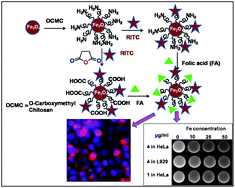
This article delineates the design and synthesis of a novel, bio-functionalized, magneto-fluorescent multifunctional nanoparticles suitable for cancer-specific targeting, detection and imaging. Biocompatible, hydrophilic, magneto-fluorescent nanoparticles with surface-pendant amine, carboxyl and aldehyde groups were designed using o-carboxymethyl chitosan (OCMC). The free amine groups of OCMC stabilized magnetite nanoparticles on the surface allow for the covalent attachment of a fluorescent dye such as rhodamine isothiocyanate (RITC) with the aim to develop a magneto-fluorescent nanoprobe for optical imaging. In order to impart specific cancer cell targeting properties, folic acid and its aminated derivative was conjugated onto these magneto-fluorescent nanoparticles using different pendant groups (–NH2, –COOH, –CHO). These newly synthesized iron-oxide folate nanoconjugates (FA-RITC-OCMC-SPIONs) showed excellent dispersibility, biocompatibility and good hydrodynamic sizes under physiological conditions which were extensively studied by a variety of complementary techniques. The cellular internalization efficacy of these folate-targeted and its non-targeted counterparts were studied using a folate-overexpressed (HeLa) and a normal (L929 fibroblast) cells by fluorescence microscopy and magnetically activated cell sorting (MACS). Cell-uptake behaviors of nanoparticles clearly demonstrate that cancer cells over-expressing the human folate receptor internalized a higher level of these nanoparticle–folate conjugates than normal cells. These folate targeted nanoparticles possess specific magnetic properties in the presence of an external magnetic field and the potential of these nanoconjugates as T2-weighted negative contrast MR imaging agent were evaluated in folate-overexpressed HeLa and normal L929 fibroblast cells.
You have access to this article
 Please wait while we load your content...
Something went wrong. Try again?
Please wait while we load your content...
Something went wrong. Try again?


 SCHEDULED MAINTENANCE