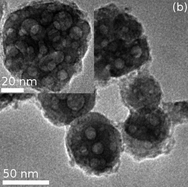
A significant obstacle in the development of YAG:Ce nanoparticles as light converters in white LEDs and as biological labels is associated with the difficulty of finding preparative conditions that allow simultaneous control of structure, particle size and size distribution, while maintaining the optical properties of bulk samples. Preparation conditions frequently involve high-temperature treatments of precursors (up to 1400 °C), which result in increased particle size and aggregation, and lead to oxidation of Ce(III) to Ce(IV). We report here a process that we term protected annealing, that allows the thermal treatment of preformed precursor particles at temperatures up to 1000 °C while preserving their small size and state of dispersion. In a first step, pristine nanoparticles are prepared by a glycothermal reaction, leading to a mixture of YAG and boehmite crystalline phases. The preformed nanoparticles are then dispersed in a porous silica. Annealing of the composite material at 1000 °C is followed by dissolution of the amorphous silica by hydrofluoric acid to recover the annealed particles as a colloidal dispersion. This simple process allows completion of YAG crystallization while preserving their small size. The redox state of Ce ions can be controlled through the annealing atmosphere. The obtained particles of YAG:Ce (60 ± 10 nm in size) can be dispersed as nearly transparent aqueous suspensions, with a luminescence quantum yield of 60%. Transparent YAG:Ce nanoparticle-based films of micron thickness can be deposited on glass substrates using aerosol spraying. Films formed from particles prepared by the protected annealing strategy display significantly improved photostability over particles that have not been subject to such annealing.
You have access to this article
 Please wait while we load your content...
Something went wrong. Try again?
Please wait while we load your content...
Something went wrong. Try again?


 SCHEDULED MAINTENANCE


