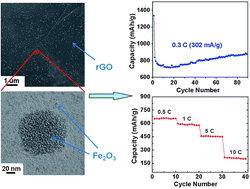
We report an environment-friendly approach to synthesize transition metal oxide nanoparticles (NPs)/reduced graphene oxide (rGO) sheets hybrids by combining the reduction of graphene oxide (GO) with the growth of metal oxide NPs in one step. Either Fe2O3 or CoO NPs were grown onto rGO sheets in ethanol solution through a solvothermal process, during which GOs were reduced to rGO without the addition of any strong reducing agent, e.g.hydrazine, or requiring any post-high-temperature annealing process. The GO or rGO during the precipitation of metal oxide NPs may act as heterogeneous nucleation seeds to facilitate the formation of small crystal grains. This may allow more efficient diffusion of Li ions and lead to high specific capacities. These metal oxide NPs–rGO hybrids were used as anodes for Li-ion batteries, which showed high capacities and excellent charge–discharge cycling stability in the voltage window between 0.01 and 3.0 V. For example, Fe2O3 NPs/rGO hybrids showed specific capacity of 881 mA h g−1 in the 90th cycle at a discharge current density of 302 mA g−1 (0.3 C), while CoO NPs/rGO hybrids showed a lower capacity of 600 mA h g−1 in the 90th cycle at a discharge current density of 215 mA g−1 (0.3 C). These nanohybrids also show excellent capacities at high C rate currents, e.g. 611 mA h g−1 for Fe2O3/rGO sample in the 300th cycle at 2014 mA g−1 (2 C). Such synthesis technique can be a promising route to produce advanced electrode materials for Li-ion batteries.
You have access to this article
 Please wait while we load your content...
Something went wrong. Try again?
Please wait while we load your content...
Something went wrong. Try again?


 SCHEDULED MAINTENANCE