This website uses cookies to give you the best user experience. If you continue
without changing your settings we'll assume you are happy to receive all RSC cookies.
You can change your cookie settings by navigating to our Privacy and Cookies page and following the instructions. These instructions
are also obtainable from the privacy link at the bottom of any RSC page.
Department of Materials Science and Engineering, Massachusetts Institute of Technology, Cambridge, USA
E-mail: xjia@mit.edu.
; Tel: +617 253 6860
b
Divisão de Metrologia de Materiais, Instituto Nacional de Metrologia, Normalização e Qualidade Industrial (INMETRO), Duque de Caxias, Brazil
E-mail: jessica.mex@gmail.com
c
Exotic Nanocarbon Research Center, Shinshu University, Wakasato 4-17-1, Nagano, Japan
E-mail: mtterrones@shinshu-u.ac.jp
d
Department of Physics and Materials Research Institute, The Pennsylvania State University, 104 Davey Lab., University Park, USA
E-mail: mut11@psu.edu
e
Department of Physics, Applied Physics, and Astronomy, Rensselaer Polytechnic Institute, Troy, USA
E-mail: meuniv@rpi.edu
f
Department of Physics and Department of Electrical Engineering and Computer Science, Massachusetts Institute of Technology, Cambridge, USA
E-mail: millie@mgm.mit.edu
Nanoscale, 2011,3, 86-95
DOI:
10.1039/C0NR00600A
Received
16 Aug 2010,
Accepted
09 Oct 2010
First published online
22 Nov 2010
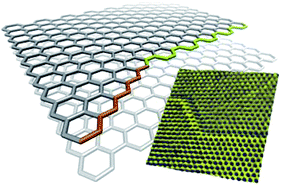
The current status of graphene edge fabrication and characterization is reviewed in detail. We first compare different fabrication methods, including the chemical vapor deposition method, various ways of unzipping carbon nanotubes, and lithographic methods. We then summarize the different edge/ribbon structures that have been produced experimentally or predicted theoretically. We discuss different characterization tools, such as transmission electron microscopy and Raman spectroscopy, that are currently used for evaluating the edge quality as well as the atomic structures. Finally, a detailed discussion of defective and folded edges is also presented. Considering the short history of graphene edge research, the progress has been impressive, and many further advances in this field are anticipated.
Fetching data from CrossRef. This may take some time to load.