This website uses cookies to give you the best user experience. If you continue
without changing your settings we'll assume you are happy to receive all RSC cookies.
You can change your cookie settings by navigating to our Privacy and Cookies page and following the instructions. These instructions
are also obtainable from the privacy link at the bottom of any RSC page.
Institute of Medical Microbiology, Immunology and Parasitology – Pharmaceutical Microbiology Section, University of Bonn, Meckenheimer Allee 168, Bonn, Germany
E-mail: sahl@microbiology-bonn.de
; Fax: +49-228-73-5267
; Tel: +49-228-73-5272
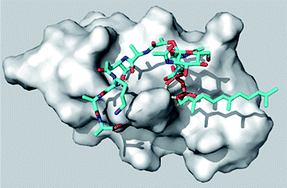
Defensins are small basic amphiphilic peptides (up to 5 kDa) that have been shown to be important effector molecules of the innate immune system of animals, plants and fungi. In addition to immune modulatory functions, they have potent direct antimicrobial activity against a broad spectrum of bacteria, fungi and/or viruses, which makes them promising lead compounds for the development of next-generation antiinfectives. The mode of antibiotic action of defensins was long thought to result from electrostatic interaction between the positively charged defensins and negatively charged microbial membranes, followed by unspecific membrane permeabilization or pore-formation. Microbial membranes are more negatively charged than human membranes, which may explain to some extent the specificity of defensin action against microbes and associated low toxicity for the host. However, research during the past decade has demonstrated that defensin activities can be much more targeted and that microbe-specific lipid receptors are involved in the killing activity of various defensins. In this respect, human, fungal and invertebrate defensins have been shown to bind to and sequester the bacterial cell wall building block lipid II, thereby specifically inhibiting cell wallbiosynthesis. Moreover, plant and insect defensins were found to interact with fungal sphingolipid receptors, resulting in fungal cell death. This review summarizes the current knowledge on the mode of action and structure of defensins from different kingdoms, with specific emphasis on their interaction with microbial lipid receptors.
Fetching data from CrossRef. This may take some time to load.