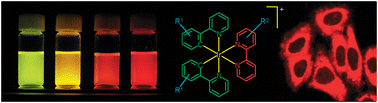
A number of luminescent iridium(III) polypyridine complexes have been designed as molecular sensors owing to their rich photophysical properties such as intense, long-lived and environment-sensitive emission. In particular, many complexes exhibit emissive behavior that can be readily controlled using various Werner-type and cyclometalating ligands. In this Perspective, we review some recent examples of luminescent iridium(III) polypyridine complexes as probes for chemical and biological molecules using different strategies. The targets include proton, cations and anions, small molecules, nucleic acids and protein molecules. There is also a recent interest in luminescent iridium(III) polypyridine complexes as cellular probes and imaging reagents; selected examples in these areas are described.
You have access to this article
 Please wait while we load your content...
Something went wrong. Try again?
Please wait while we load your content...
Something went wrong. Try again?