


 SCHEDULED MAINTENANCE

Synthesis and characterization of IMPY derivatives that regulate metal-induced amyloid-β aggregation†
Abstract
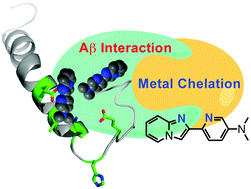
Metal ions associated with amyloid-β (Aβ) species have been suggested to be involved in neurodegeneration leading to the progression of Alzheimer's disease (AD). The role of metal-involved Aβ species in AD neuropathogenesis, however, is not fully elucidated. In order to advance this understanding and contribute to the therapeutic development for AD, the rational structure-based design of small molecules that specifically target metal ions surrounded by Aβ species has recently received increased attention. To date, only a few compounds have been fashioned for this purpose. Herein, we report the design strategy, synthesis, characterization, and reactivity of new bifunctional IMPY derivatives K1 and K2. Using
- This article is part of the themed collection: Metals in Neurodegenerative Disease
 Please wait while we load your content...