This website uses cookies to give you the best user experience. If you continue
without changing your settings we'll assume you are happy to receive all RSC cookies.
You can change your cookie settings by navigating to our Privacy and Cookies page and following the instructions. These instructions
are also obtainable from the privacy link at the bottom of any RSC page.
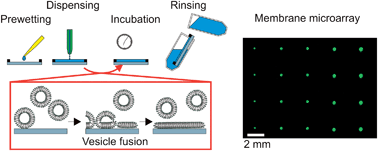
Arrays of supported lipid bilayers (SLBs) provide great potential for future drug development and multiplexed biological research, but are difficult to prepare due to the sensitivity of both the lipid and protein structural arrangement to air exposure. A novel way to produce arrays of SLBs is presented based on non-contact dispensing of vesicles to a substrate through a thin surface confined water film. The approach presents many degrees of freedom since it is not limited to a specific substrate, lipid composition, linker or controlled environment. The method allows adjustment of spot size (180–360 μm) by repeated dispensing as well as control over the composition of the spots and subsequent analytes. SLB formation by vesicle adsorption and rupture allows for incorporation of membraneproteins through pre-formed proteoliposomes. Dispensing through a dip-and-rinse water film avoids contamination, disruptive drying and the need for complex buffer compositions. Furthermore, no humidity control is necessary which simplifies the production step and prolongs the life-time of the spotting system. We characterize the method with respect to control over spot size, bilayer mobility and the formation process as well as demonstrate the possibility to fuse bilayer spots with subsequently added vesicles. Since complex lipid compositions and multiple spotting nozzles can be used, this novel technique is expected to be a promising platform for future applications, e.g.patterning to monitor peptide/protein–lipid interactions, for glycomics using glycolipids or lipopolysaccharides, and to study mixing of spatially confined lipidmembranes.
Fetching data from CrossRef. This may take some time to load.