This website uses cookies to give you the best user experience. If you continue
without changing your settings we'll assume you are happy to receive all RSC cookies.
You can change your cookie settings by navigating to our Privacy and Cookies page and following the instructions. These instructions
are also obtainable from the privacy link at the bottom of any RSC page.
Journal of Materials Chemistry was published between 1991 and 2012. From issue 1, 2013, it was replaced by three new journals: Journal of Materials Chemistry A, B and C
Key Laboratory of Mineralogy and Metallogeny, Guangzhou Institute of Geochemistry, Chinese Academy of Sciences, Guangzhou, P. R. China
E-mail: hehp@gig.ac.cn
b
Chemistry Discipline, Faculty of Science and Technology, Queensland University of Technology, Brisbane, Australia
E-mail: r.frost@qut.edu.au
J. Mater. Chem., 2011,21, 10711-10719
DOI:
10.1039/C1JM10328H
Received
21 Jan 2011,
Accepted
04 May 2011
First published online
22 Jun 2011
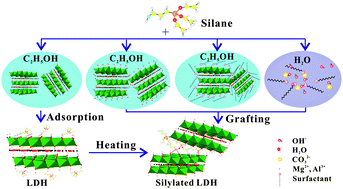
A series of layered double hydroxides (LDHs) based composites were synthesized by using an induced hydrolysissilylation (IHS) method, surfactant precursor method, in situcoprecipitation method, and direct silylation method. Their structures, morphologies, bonding modes and thermal stabilities can be readily adjusted by changing the parameters during preparation and drying processing of the LDHs. The characterization results show that the direct silylation reaction cannot occur between the dried LDHs and 3-aminopropyltriethoxysilane (APS) in an ethanol medium. However, the condensation reaction can proceed with a heating process between the adsorbed APS and LDHs plates. While using wet state substrates with and without surfactant and ethanol as the solvent, the silylation process can be induced by the hydrolysis of APS on the surface of the LDHs plates. Surfactants improve the hydrophobicity of the LDHs during the process of nucleation and crystallization, resulting in fluffy shaped crystals; meanwhile, they occupy the surface –OH positions and leave less “free –OH” available for the silylation reaction, favoring the formation of silylated products with a higher population in the hydrolyzed bidentate (T2) and tridentate (T3) bonding forms. These bonding characteristics lead to spherical aggregates and tightly bonded particles. All silylated products show higher thermal stability than those of pristine LDHs.
Fetching data from CrossRef. This may take some time to load.
This may take some time to load.
Journal of Materials Chemistry
- Information Point
This text is added as a work around for heading error in Accessibility testing