This website uses cookies to give you the best user experience. If you continue
without changing your settings we'll assume you are happy to receive all RSC cookies.
You can change your cookie settings by navigating to our Privacy and Cookies page and following the instructions. These instructions
are also obtainable from the privacy link at the bottom of any RSC page.
Center for Green Chemistry and Green Engineering at Yale, 225 Prospect Street, New Haven, CT
E-mail: evan.beach@yale.edu
; Fax: +1 203-436-8574
; Tel: +1 203-432-5215
Green Chem., 2011,13, 1399-1405
DOI:
10.1039/C1GC00015B
Received
04 Jan 2011,
Accepted
01 Mar 2011
First published online
04 Apr 2011
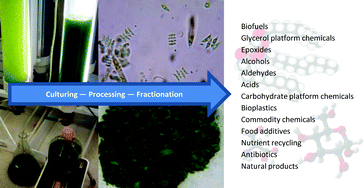
Algae are being explored as a sustainable energy feedstock, having potential to reduce dependence on petrofuels and offset greenhouse gas emissions. Economic considerations and principles of green design suggest that if algae-to-fuel technology is to be successful, biofuels must be produced simultaneously with value-added co-products. At present, the algae industry is centered around a limited number of products, such as low-volume/high-value speciality nutrients. New products for medium- and high-volume markets will be needed as biomass production increases in scale. This Perspective highlights non-fuel applications of algal biomass that have received relatively little attention to date but are promising for future development. It is our goal to draw attention to some of the unique opportunities that algae present with respect to biochemical composition as compared to lignocellulosic energy crops.
Fetching data from CrossRef. This may take some time to load.