This website uses cookies to give you the best user experience. If you continue
without changing your settings we'll assume you are happy to receive all RSC cookies.
You can change your cookie settings by navigating to our Privacy and Cookies page and following the instructions. These instructions
are also obtainable from the privacy link at the bottom of any RSC page.
Key Laboratory for Molecular Enzymology and Engineering of Ministry of Education, Jilin University, 2699 Qianjin Road, Changchun, P. R. China
E-mail: fangxx@jlu.edu.cn
; Fax: +86-431-85155240
; Tel: +86-431-85155249
Green Chem., 2011,13, 1869-1875
DOI:
10.1039/C1GC15114B
Received
29 Jan 2011,
Accepted
19 Apr 2011
First published online
06 Jun 2011
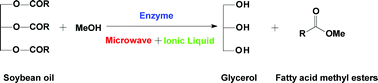
Under microwave irradiation (MW), an ionic liquid (IL) was used as reaction medium to produce biodiesel (fatty acid methyl ester, FAME) with soybean oil and methanol through transesterification by Novozym 435. [EMIM][PF6] was proved to be a good reaction medium for biodiesel production because the enzyme exhibited excellent transesterification activity in it. Under MW, the enzyme activity in [EMIM][PF6] was about 1.8 folds higher than that in tert-butanol, and under conventional heating, about 1.2 folds higher than that in tert-butanol. Under the optimum conditions (microwave power of 480 W, [EMIM][PF6]/oil volume ratio of 2:1, methanol/oil molar ratio of 6:1, 6% amount Novozym 435 based on soybean oil weight, water activity of 0.33, agitation speed of 200 rpm, and 60 °C), a 92% yield of FAME was achieved in 6 h in [EMIM][PF6] under MW, whereas the yield of FAME in [EMIM][PF6] without MW and in a solvent-free system with MW was 70% and 28%, respectively. The results suggested that MW and IL might have a synergistic effect on improving enzyme activity. The enhancement of enzyme activity might be that the microwave acted directly on the IL because of its excellent microwave-absorbing ability, which created a compatible system for both the substrate and the product, and prevented the deactivation of enzyme with methanol and glycerol. The introduction of IL in microwave system might also increase the velocity of transacylation, and increase the enzyme activity indirectly. Furthermore, recovered IL and enzyme were used for five successive reaction cycles without any significant loss of enzyme activity.
Fetching data from CrossRef. This may take some time to load.