



Nanoprobe X-ray fluorescence characterization of defects in large-area solar cells†
Abstract
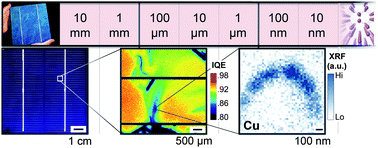
The performance of centimeter-sized energy devices is regulated by inhomogeneously distributed nanoscale defects. To improve device efficiency and reduce cost, accurate characterization of these nanoscale defects is necessary. However, the multiscale nature of this problem presents a characterization challenge, as non-destructive techniques often specialize in a single decade of length scales, and have difficulty probing non-destructively beneath the surface of materials with sub-micron spatial resolution. Herein, we push the resolution limits of synchrotron-based nanoprobe X-ray fluorescence mapping to 80 nm, to investigate a recombination-active intragranular defect in industrial solar cells. Our nano-XRF measurements distinguish fundamental differences between benign and deleterious dislocations in solar cell devices: we observe recombination-active dislocations to contain a high degree of nanoscale iron and copper decoration, while recombination-inactive dislocations appear clean. Statistically meaningful high-resolution measurements establish a connection between commercially relevant materials and previous fundamental studies on intentionally contaminated model defect structures, pointing the way towards optimization of the industrial solar cell process. Moreover, this study presents a hierarchical characterization approach that can be broadly extended to other nanodefect-limited energy systems with the advent of high-resolution X-ray imaging beamlines.
 Please wait while we load your content...


