This website uses cookies to give you the best user experience. If you continue
without changing your settings we'll assume you are happy to receive all RSC cookies.
You can change your cookie settings by navigating to our Privacy and Cookies page and following the instructions. These instructions
are also obtainable from the privacy link at the bottom of any RSC page.
A journal linking all aspects of the chemical, physical and biotechnological sciences relating to energy conversion and storage, alternative fuel technologies and environmental science.
Department of Energy, Environmental and Chemical Engineering, Washington University, St. Louis
E-mail: ysjun@seas.wustl.edu
; Fax: +(314) 935-7211
; Tel: +(314) 935-4539
b
Department of Chemical and Environmental Engineering, Yale University, New Haven
Energy Environ. Sci., 2011,4, 4596-4606
DOI:
10.1039/C1EE01890F
Received
04 Jun 2011,
Accepted
08 Aug 2011
First published online
21 Sep 2011
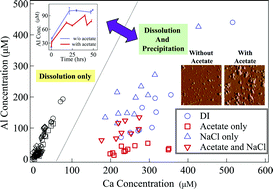
Acetate is one of the most abundant organic compounds in many formation waters and is likely to be present in deep saline aquifers suitable for geologic CO2 sequestration (GCS). This work studied the effect of initially present acetate on the dissolution of anorthite (CaAl2Si2O8) and on subsequent secondary mineralprecipitation under GCS conditions (35 °C and 74.8 atm). Anorthite was chosen as a model mineral because of the abundance of feldspar in clayey sandstones and the possibility of metal carbonation. In this study, acetate was found to decrease the cumulative aqueous concentrations of Al, Si, and Ca upon CO2 injection by inhibiting anorthite dissolution and increasing the amount of secondary mineral precipitates. The extent of the effect of acetate on metal concentration changes was element-specific (Al > Si > Ca), and the effect was found to be more significant in systems with lower salinity and lower pH. For anorthite dissolution, acetic acid inhibited the proton-mediated decomposition of the Al/Si-containing feldspar framework, while acetate anions may have facilitated the ion-exchange between interstitial Ca and aqueous cations. For secondary mineralprecipitation, stoichiometry analysis of aqueous metal concentrations suggested the formation of Al-containing mineral(s). The presence of kaolinite as a secondary mineral was confirmed using high resolution transmission electron microscopy's electron diffraction data. An increase in the relative amount of precipitation due to the initial presence of acetate was suggested by mass balancing and verified on the cleaved anorthite surfaces by atomic force microscopy analysis. These results provide new insights for understanding and predicting GCS system evolution upon scCO2 injection in the initial presence of acetate.
Fetching data from CrossRef. This may take some time to load.
This may take some time to load.
Energy & Environmental Science
- Information Point