This website uses cookies to give you the best user experience. If you continue
without changing your settings we'll assume you are happy to receive all RSC cookies.
You can change your cookie settings by navigating to our Privacy and Cookies page and following the instructions. These instructions
are also obtainable from the privacy link at the bottom of any RSC page.
A journal linking all aspects of the chemical, physical and biotechnological sciences relating to energy conversion and storage, alternative fuel technologies and environmental science.
Thomas J. Watson Laboratories of Applied Physics, California Institute of Technology, 1200 E. California Blvd, Pasadena, USA
E-mail: haa@caltech.edu
; Fax: +1 626 844-9320
; Tel: +1 626-395-2197
b
Division of Chemistry and Chemical Engineering, California Institute of Technology, 1200 E. California Blvd, Pasadena, USA
E-mail: nslewis@caltech.edu
; Fax: +1 626 395-8867
; Tel: +1 626 395-6335
c
Member, Kavli Nanoscience Institute, California Institute of Technology, USA
Energy Environ. Sci., 2011,4, 866-871
DOI:
10.1039/C0EE00549E
Received
12 Oct 2010,
Accepted
24 Nov 2010
First published online
07 Jan 2011
This article is part of themed collection:
Solar energy
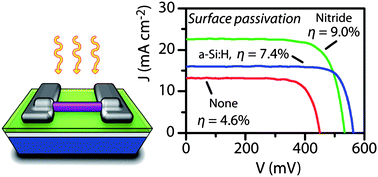
Crystalline Si wires, grown by the vapor–liquid–solid (VLS) process, have emerged as promising candidate materials for low-cost, thin-film photovoltaics. Here, we demonstrate VLS-grown Si microwires that have suitable electrical properties for high-performance photovoltaic applications, including long minority-carrier diffusion lengths (Ln ≫ 30 µm) and low surface recombination velocities (S ≪ 70 cm·s−1). Single-wire radial p–n junction solar cells were fabricated with amorphous silicon and silicon nitride surface coatings, achieving up to 9.0% apparent photovoltaic efficiency, and exhibiting up to 600 mV open-circuit voltage with over 80% fill factor. Projective single-wire measurements and optoelectronic simulations suggest that large-area Si wire-array solar cells have the potential to exceed 17% energy-conversion efficiency, offering a promising route toward cost-effective crystalline Si photovoltaics.
Fetching data from CrossRef. This may take some time to load.
This may take some time to load.
Energy & Environmental Science
- Information Point