This website uses cookies to give you the best user experience. If you continue
without changing your settings we'll assume you are happy to receive all RSC cookies.
You can change your cookie settings by navigating to our Privacy and Cookies page and following the instructions. These instructions
are also obtainable from the privacy link at the bottom of any RSC page.
A journal linking all aspects of the chemical, physical and biotechnological sciences relating to energy conversion and storage, alternative fuel technologies and environmental science.
Department of Materials Science and Engineering, University of Wisconsin—Madison, Madison, USA
E-mail: xudong@engr.wisc.edu
; Fax: +1 608-2628353
; Tel: +1 608-8902667
Energy Environ. Sci., 2011,4, 4508-4512
DOI:
10.1039/C1EE02241E
Received
29 Jul 2011,
Accepted
19 Aug 2011
First published online
15 Sep 2011
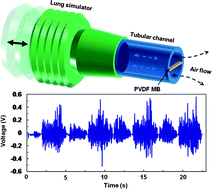
In this paper, we report a technique that uses piezoelectric polyvinylidene fluoride (PVDF) microbelts to convert the energy from low-speed air flow to electricity via their resonant oscillation. The micrometre thick PVDF thin films were fabricated by a top-down reactive ion etching process, where the thickness was controlled by etching time and the piezoelectric phase was well preserved. The thickness, air flow speed and electrical output relationship was predicted theoretically and characterized experimentally. The PVDF microbelts were able to generate sufficient electrical energy from low speed air flow for the sustained operation of small electronic devices. Their capability for harvesting energy from simulated respiration was also demonstrated.
Fetching data from CrossRef. This may take some time to load.
Energy & Environmental Science
- Information Point