



All-carbon-nanofiber electrodes for high-energy rechargeable Li–O2 batteries†
Abstract
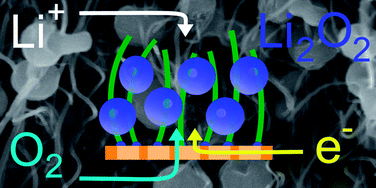
Hollow carbon fibers with diameters on the order of 30 nm were grown on a ceramic porous substrate, which was used as the oxygen electrode in lithium-oxygen (Li–O2) batteries. These all-carbon-fiber (binder-free) electrodes were found to yield high gravimetric energies (up to 2500 W h kgdischarged−1) in Li–O2cells, translating to an energy enhancement ∼4 times greater than the state-of-the-art lithium intercalation compounds such as LiCoO2 (∼600 W h kgelectrode−1). The high gravimetric energy achieved in this study can be attributed to low carbon packing in the grown carbon-fiber electrodes and highly efficient utilization of the available carbon mass and void volume for Li2O2 formation. The nanofiber structure allowed for the clear visualization of Li2O2 formation and morphological evolution during discharge and its disappearance upon charge, where Li2O2 particles grown on the sidewalls of the aligned carbon fibers were found to be toroids, having particle sizes increasing (up to ∼1 μm) with increasing depth-of-discharge. The visualization of Li2O2 morphologies upon discharge and disappearance upon charge represents a critical step toward understanding key processes that limit the rate capability and low round-trip efficiencies of Li–O2 batteries, which are not currently understood within the field.
 Please wait while we load your content...


